Trying to make sense of Brookline condo fees? You are not alone. Monthly fees vary widely from building to building, which makes budgeting tricky if you are comparing a Coolidge Corner brownstone to a newer building near Brookline Village. In this guide, you will learn what condo fees typically cover, what they do not, how fees differ by building type, and how to review documents so you can budget with confidence. Let’s dive in.
What drives Brookline condo fees
Condominium associations in Brookline operate under Massachusetts General Laws Chapter 183A. That framework guides how associations budget, assess fees and disclose information to buyers. The master deed and bylaws for each association determine exactly what is included and how costs are shared among unit owners.
Property taxes in Massachusetts are usually paid directly by each unit owner to the Town of Brookline. They are not typically part of your monthly condo fee. Plan to budget separately for your Brookline property tax bills.
Local services also matter. The town maintains public ways, but associations often arrange private trash removal, snow shoveling for entries and sidewalks, and landscaping for common areas. These contracts are common line items you will see in a Brookline condo budget.
What condo fees usually include
Every building is different, but most Brookline condo budgets contain versions of the categories below. Your final list should be confirmed in the association’s budget, master deed and bylaws.
Utilities
- Water and sewer: Sometimes included if the building has a bulk meter. Smaller brownstones may have individual meters and owners pay directly.
- Heat and hot water: Older brownstones often have individual in-unit systems. Mid and high-rises commonly have central plants, which means heat and hot water are included in the fee.
- Electricity: In-unit electricity is typically an owner expense. Condo fees usually cover common-area electricity for hallways, exterior lights and elevators.
- Trash and recycling: Many associations contract private hauling and include it in the fee. Some small associations handle this informally or pay per unit.
- Cable or Internet: A few newer or luxury buildings negotiate bulk packages that are included, but most owners choose and pay their own providers.
Insurance and liability
- Master policy: The association carries a policy that covers common areas and, depending on form, some elements of unit interiors. Confirm whether it is bare walls or walls-in.
- Owner insurance: You will still carry an HO-6 policy to cover your personal property, liability and your portion of the unit that the master policy does not cover. The master policy deductible is an important detail to ask about.
Maintenance and exterior upkeep
- Common areas: Cleaning, lighting, basic supplies and routine maintenance are funded by fees.
- Exterior: Roof, façade, masonry, paint and windows are usually association responsibilities. The master deed defines the boundary of responsibility.
- Landscaping and snow removal: Most Brookline associations include seasonal landscaping and shoveling of stoops, steps and walkways.
- Elevators and mechanicals: Larger buildings have ongoing service contracts that appear in the budget.
Reserves and capital funding
- Reserve contributions: Most associations set aside money for future big-ticket projects like roofs and mechanical systems. A healthy reserve helps reduce the risk of special assessments.
- Special assessments: If reserves are low or a surprise project arises, the association can levy a special assessment to fund the work.
Amenities, staff and services
- On-site staff: Superintendents, concierge, door staff and porters add convenience, and they also raise monthly fees.
- Amenities: Pools, gyms, common rooms, roof decks, parcel rooms and bicycle storage require maintenance that is paid from fees.
- Security and monitoring: Cameras and access systems often involve contracted services.
Parking, storage and extras
- Parking: Spaces may be deeded, assigned, or rented. Some associations include parking in the fee, while others charge a separate monthly amount.
- Storage: Lockers or bike rooms may be included or billed separately depending on the building.
Administrative and management costs
- Management fees: Many Brookline associations are professionally managed and pay an ongoing fee.
- Legal and accounting: Tax preparation, legal counsel, insurance brokerage, office supplies and meeting costs are common budget lines.
What condo fees do not cover
- Property taxes: Owners usually pay the Town of Brookline directly. These are separate from your condo fee.
- Mortgage payments and your personal bills.
- Interior unit repairs and ordinary appliance replacement unless your documents specify otherwise.
- Owner-paid utilities for individually metered services, such as in-unit electricity or gas.
- Your personal HO-6 policy for contents and liability.
Brownstones vs newer buildings
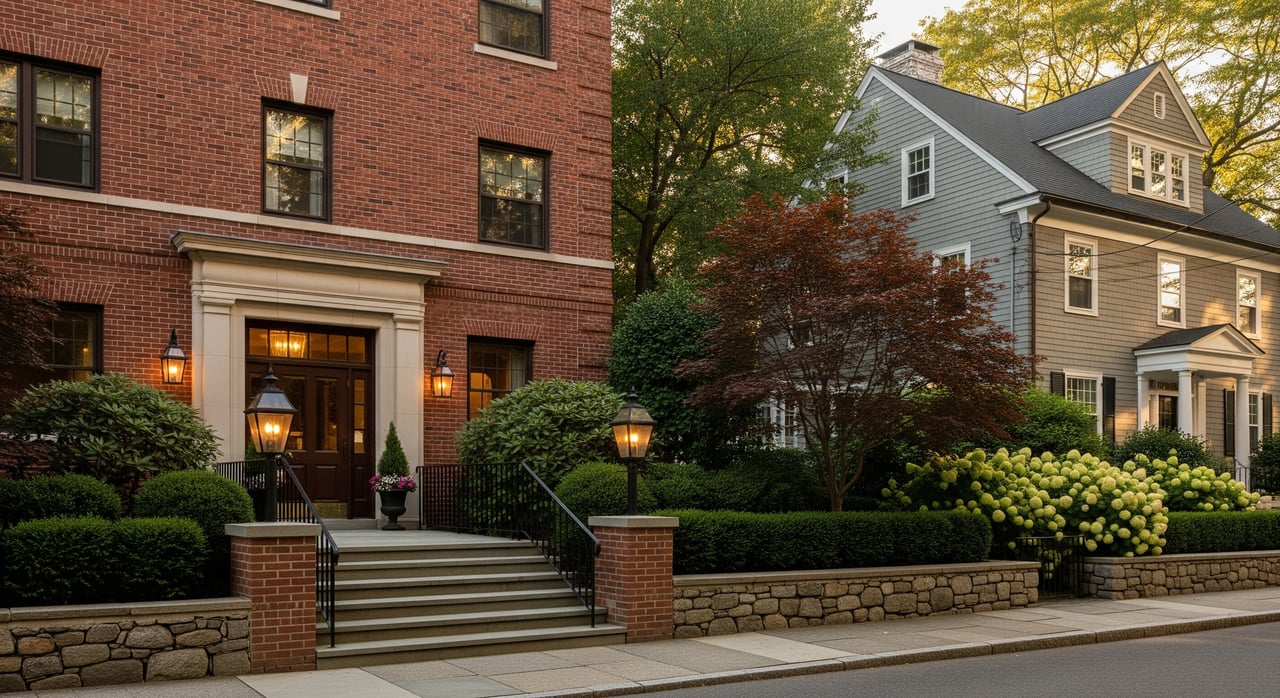
Brookline has a mix of 19th and early 20th century brownstones and newer mid and high-rises. Each type tends to handle fees differently.
Brownstones
- Association size: Often 2 to 6 units and sometimes self-managed.
- Typical inclusions: Basic common-area care, exterior maintenance, landscaping and shared snow removal. Water and sewer may be included if billed in bulk.
- Typical exclusions: In-unit heat and hot water are frequently owner-paid, and electricity is usually separate.
- Fees and reserves: Monthly fees are often lower, but reserve funds are sometimes lean. That increases the chance of special assessments for projects like roof replacement or masonry repointing.
- Insurance: Master policies may be bare walls. Strong HO-6 coverage is important.
Mid and high-rises
- Association size: Dozens to hundreds of units, usually with professional management.
- Typical inclusions: Heat and hot water from central systems, common-area utilities, elevator service, security or concierge, trash removal and often amenities.
- Fees and reserves: Monthly fees are higher to support staffing and amenities, but reserves are commonly better funded with more formal capital planning.
- Buyer focus: Review the reserve study, recent capital projects and how amenity costs are allocated.
Conversions and mixed buildings
- These can be idiosyncratic. You might see shared steam heat, centralized laundry or partial utility inclusion. Confirm details in the master deed and budget.
Review fees like a pro
Before you commit, gather the right documents and ask targeted questions. This is the best way to understand what your fee buys you and what it does not.
Documents to request
- Current annual budget and recent interim financials.
- Reserve study if available, plus the current reserve balance.
- Minutes from the past 12 to 36 months of association meetings.
- Master deed and bylaws to confirm inclusions and responsibilities.
- Master insurance declarations, including coverage type and deductible.
- Special assessment history for the last five years and any schedule of assessments.
- Management contract and key vendor contracts, such as elevator, landscaping and snow removal.
- Unit allocation schedule and any parking or storage agreements.
- Notices of pending litigation, building violations or enforcement actions.
Questions to ask
- Exactly what is included in the monthly fee? Get a line-item list.
- Are utilities metered individually or paid in bulk? How are costs allocated among units?
- How is the reserve funded and when was the last reserve study? Is there a capital plan?
- Have there been recent special assessments or upcoming projects?
- What is the master insurance deductible and does the policy cover common elements only or walls-in?
- Who handles daily management and what are management fees?
- Are parking spaces deeded or rented, and are they included in the monthly fee or billed separately?
- Are there rental, pet or short-term rental policies that could affect your plans?
Red flags for higher cost risk
- Low reserve balances or no reserve study.
- Frequent special assessments in the association’s history.
- High master policy deductibles that shift more cost to owners after a claim.
- Deferred exterior maintenance in small, owner-managed buildings.
- Large capital projects disclosed in minutes or budgets without a funding plan.
Simple budgeting examples
Below are illustrative scenarios to show how inclusions and building type can change your monthly fee. Actual fees vary by building and should be verified in current budgets.
Example: Small brownstone near Coolidge Corner
- Common-area maintenance: $75 per month
- Landscaping and snow removal: $30 per month
- Master insurance portion: $25 per month
- Association utilities like common water/sewer: $20 per month
- Reserve contribution: $50 per month
- Management and admin: $25 per month
- Total illustrative fee: $225 per month
Likely exclusions: In-unit heat and hot water, in-unit electricity, interior repairs and property taxes. Notes: Lower fees can look attractive, but small reserves raise the chance of special assessments for big projects like roof or masonry work.
Example: Mid or high-rise near Brookline Village
- Common-area utilities and elevator: $150 per month
- Heat and hot water from a central plant: $200 per month
- Concierge, staffing and cleaning: $250 per month
- Amenities like a gym, roof deck or pool: $100 per month
- Master insurance and liability: $75 per month
- Reserve contribution: $200 per month
- Management, admin and legal: $125 per month
- Total illustrative fee: $1,100 per month
Likely inclusions: Heat, hot water, common electricity, trash, snow removal, staffing and amenity access. Notes: Higher monthly fees support services and planning that can reduce the likelihood of surprise assessments when reserves are well funded.
Parking and extras
Parking is often scarce in Brookline. Some buildings sell deeded spaces, while others assign or rent them monthly. You may see a separate parking maintenance fee or garage rental charge that is not part of the condo fee. Always confirm whether parking costs appear in the operating budget or as a separate line on your bill.
Smart planning tips
- Compare more than the sticker price. Weigh the nominal fee against reserve health, past assessments and upcoming projects.
- Clarify utility allocations. Ask which utilities are included, how costs are split and whether meters are individual or bulk.
- Expect taxes to be separate. Keep a separate line in your budget for Brookline property taxes.
- Budget a contingency. Consider setting aside 5 to 10 percent of your monthly housing costs for unexpected assessments or repairs.
- Tailor coverage. Match your HO-6 policy to the master policy’s coverage type and deductible so you are not exposed.
Next steps
If you are comparing two condos with very different fees, the right document review can make your decision clear. We help you request the budget, read the reserve picture and understand how amenities, staff and utilities affect your monthly number. If you are ready to evaluate a specific building, connect with the team at M|E Collective for a focused, local-first consultation.
FAQs
What do Brookline condo fees typically cover?
- Fees usually fund common utilities, insurance, routine maintenance, reserves, management and any amenities or staffing, with exact inclusions defined by the association’s documents.
Are Brookline property taxes included in condo fees?
- No, property taxes are typically paid directly by each unit owner to the Town of Brookline and are not part of the monthly condo fee.
How do brownstone fees compare to newer buildings?
- Brownstones often have lower monthly fees with leaner reserves and more owner-paid utilities, while mid and high-rises have higher fees that include more services and amenities.
What is a special assessment in a condo?
- A special assessment is an extra charge levied by the association to fund projects or costs not covered by the operating budget and reserves.
What insurance do I need if there is a master policy?
- You will still need an HO-6 policy for personal property, liability and any interior coverage not included in the master policy, and you should note the master policy deductible.
How can I confirm exactly what a specific fee includes?
- Request the current budget, master deed, bylaws and insurance declarations, then ask for a line-item list of inclusions and utility allocations from the board or manager.